// MODULAR MES
Mantsu is the modular MES layer between your ERP and your shop floor with the speed of a product and the flexibility of a custom build.
Start with one module, expand as your operations grow and prove value fast.
.png)
// OUR PRODUCT
01

Built on Mendix low-code, you start from a battle-tested template and customize it to fit your floor. You own the code, so no vendor roadmap stands between you and the next improvement.
02

Connects to the machines and systems you already have, via MQTT and OPC-UA for shop floor connectivity, and standard protocols for SAP and other ERP systems.
03

Every module works independently: start with one without committing to the rest. They all share one core layer, keeping your data consistent and connected as you grow.
// MODULES
Order Cockpit
Downtimes
Recipe Management
Quality Management
Lists
Insights
Communication Layer
The central screen for every operator: from order start to confirmation, with material consumption, downtime, quality checks, scrap and SOPs all accessible in one place.
.png)

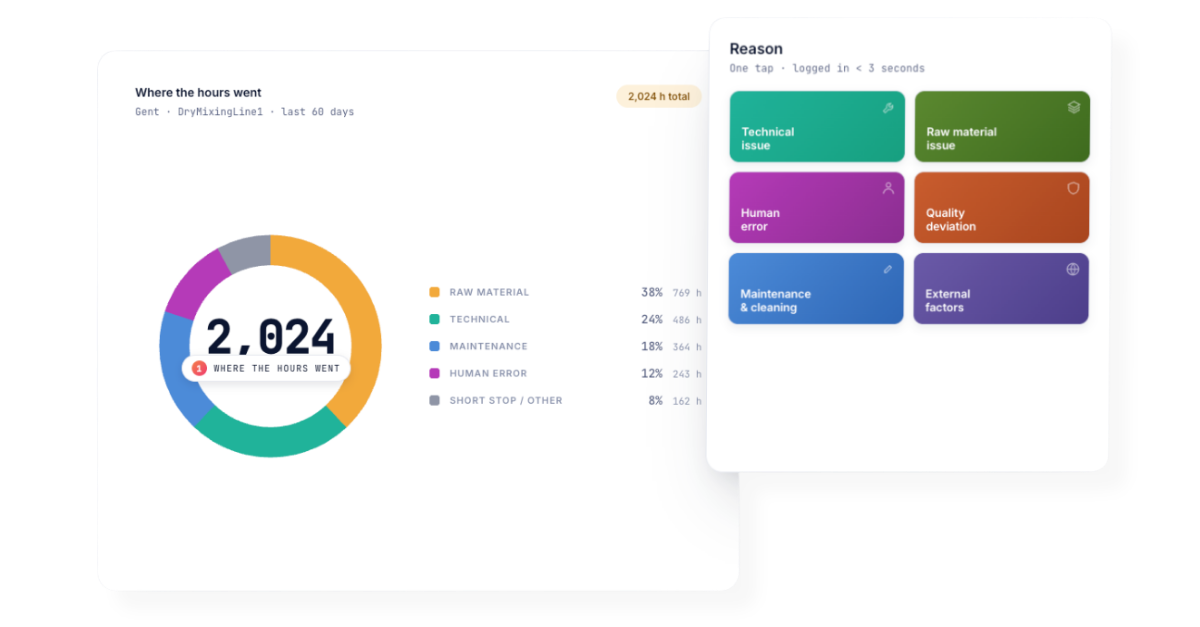
Most downtime on batch floors gets registered after the fact. From memory, rounded up, never quite accurate. The Downtimes module registers every machine stop automatically at the moment it happens, via MQTT or OPC-UA connectivity.

ERP recipes tell you what to buy. MES recipes tell your machine what to do. The Recipe Management module centralizes all production parameters and pushes them automatically to the right machine at order start.
.png)

Quality deviations caught too late become scrap. The Quality Management module brings structured inspection plans to the floor, with flexible result registration and direct connectivity to measurement equipment.
.png)

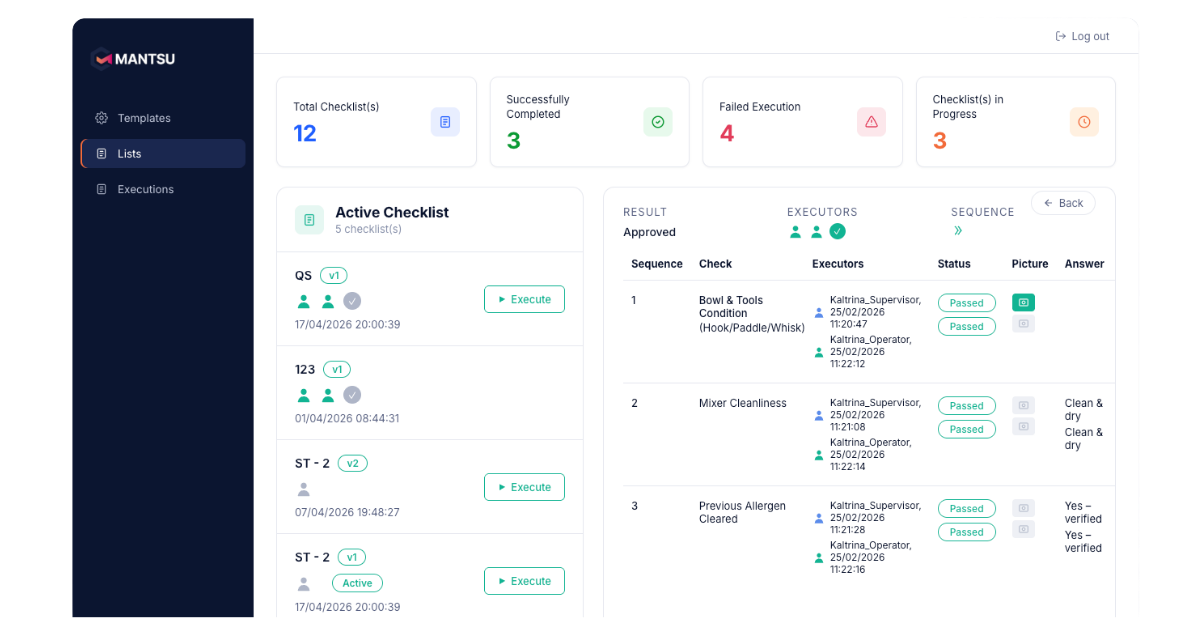
Managing SOPs (Standard Operating Procedures) on paper means you can never be sure procedures were actually followed. The Lists module digitizes your standard operating procedures, executable on tablet or terminal, with barcode scans and time-based controls that enforce physical presence at the machine.

All modules feed into one shared reporting layer: every stop, every quality result, every order confirmation captured automatically and available in one place.
.png)

Every action in Mantsu, every stop, every quality result, every order confirmation, flows through one shared event layer. That layer connects your modules to each other, your machines to Mantsu, and Mantsu to your ERP.

One central layer manages the master data every module depends on Define once, available everywhere.
Run modules closer to the machines when cloud connectivity is limited or latency matters.
Built for global production environments, on any device, in any language.
Every user sees exactly what they need: nothing more, nothing less.
The integration layer grows with your needs without requiring a development project every time.
Data flows in real-time between modules, machines, and upstream systems.
Every registration in Mantsu, material consumption, quality checks, downtime, operator actions, is linked to the batch and the production order it belongs to.
3 months
From contract to go-live
6+ modules
Based on hands-on manufacturing experience
100%
Visibility for continuous improvement
3x faster
Time to value than traditional MES project
.png)
“By choosing a modular MES, we're no longer tied to a vendor's product roadmap. When we need something on the floor, we can adapt, fast."
Stijn Van Uytfanghe
Global Digital Transformation Program Manager,
Premium Sound Solutions
// FAQ
Won't separate modules create a fragmented system?
That's exactly what the Mantsu Core prevents. Every module — Downtimes, Quality, Order Cockpit, Lists, Recipes, Insights — runs on top of one shared foundation that manages all your master data: locations, equipment, materials, and shifts. Define it once, and every module uses it.
What if we outgrow the standard Mantsu templates?
Beyond the core modules, Mantsu offers extensions built from recurring customer needs, including plant maintenance, production planning, and a kata board for continuous improvement. Use cases that keep coming up on real floors get turned into modules, so your composable MES can keep scaling without starting from scratch every time.
What does the Mantsu implementation process actually look like?
We start by getting a high-level understanding of your production process, followed by a plant tour and a deep dive into how your floor actually operates. Based on what we learn, we conduct a fit-gap analysis and document the customizations needed. From there, we build on the proven Mantsu templates and go live — first module within three months of signing.
Can our IT team maintain Mantsu themselves?
Yes, and that’s by design. Because Mantsu is built on the Mendix low-code platform, your IT team works with standard tooling and a well-documented environment. The codebase is yours, so your team can maintain, modify, and extend the system without depending on Mantsu or any other single vendor. But of course, our Mendix experts love to help.
What happens to our system if Mantsu ceases to exist as a company?
When you implement Mantsu, you receive the full codebase. Your system keeps running regardless of what happens to Mantsu as a company, because you own the code, not us. And because Mantsu is built on Mendix, a proven low-code platform with an active global community and thousands of certified partners, you can work with any Mendix partner to maintain, adapt, or extend your system.
How do Mantsu modules communicate with each other?
All modules exchange data through a shared event layer: every production event is captured and stored in a dedicated reporting database, separate from the operational modules. This keeps the operational modules lean and fast, while all data remains available for reporting and analytics via the Insights module.
Does Mantsu work with older machines that don’t have modern connectivity?
Yes. The communication layer supports MQTT and OPC-UA as standard protocols — connecting machines regardless of age or manufacturer. For machines that don’t support direct connectivity, a web service integration is available as a custom alternative.

Book a virtual demo or visit our experience center in Ghent or Kontich to see it live.